
Lead counts make a marketing report look precise. A call came in. A form got filled out. Divide the spend by the count, and there's your cost per lead. But auto repair shop leads are chances at work. A finished, paid repair is the work. Watch the gap between those two as closely as you watch the number at the top of the report.
Why more leads didn't mean more revenue
Here's a hypothetical. Two made-up shops each spend $10,000 a month on marketing. Each gets 200 leads. On the marketing report, they look almost the same.
Shop A answers nearly every call and returns missed ones fast. Its advisors are good at booking. And it has room for the work its ads bring in.
Shop B misses calls when it's busy. The schedule is backed up. Web requests sit. And it's pushing services it already struggles to fit into the bays.
Now the made-up numbers. From those same 200 leads, Shop A completes 100 jobs and Shop B completes 50. Say each completed job brings in $600. Shop A takes in $60,000. Shop B takes in $30,000. Both report a $50 cost per lead.
A few ground rules for this hypothetical. It follows the same group of leads all the way to finished work, even if the job lands in a later month. Repeat visits aren't counted. Revenue isn't profit. And the example doesn't prove what caused either result. It only shows that the same cost per lead can hide very different money.
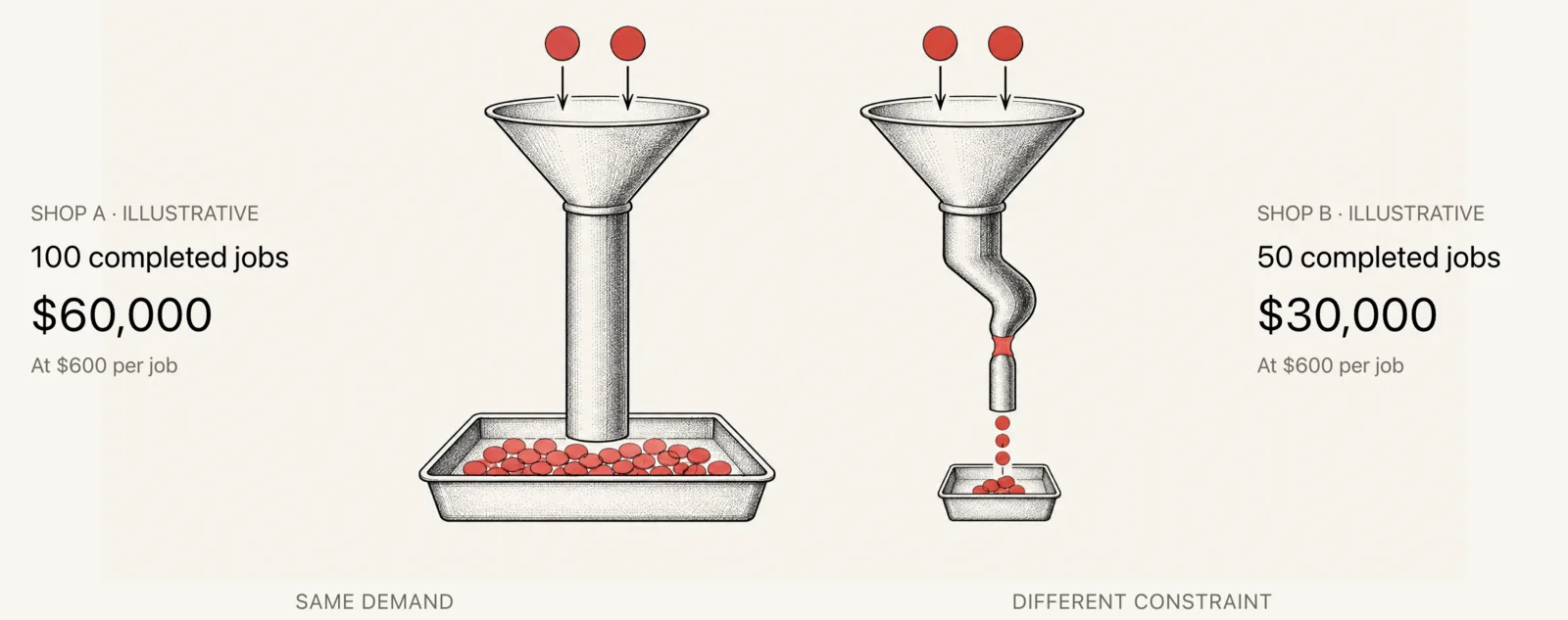
A made-up example, not client results or an industry benchmark. Two shops each spend $10,000 a month for 200 leads at $50 a lead. At $600 per completed job, Shop A's 100 jobs bring in $60,000 and Shop B's 50 jobs bring in $30,000. Same leads, different bottleneck. Revenue isn't profit.
What cost per lead can't tell you
Obvious enough. Still, a lot of auto repair shop advertising is set up as if everything after the lead is somebody else's job. The agency brings in the calls. You handle the rest.
That's fair, up to a point. A marketing company shouldn't pretend to run your shop. Your advisors and techs know the work in ways an outside agency never will.
But when marketing and the shop run as two separate worlds, you pay for it. What a lead is worth depends on your shop. A lead for profitable work you can do tomorrow isn't worth the same as a lead for work you can't get on the schedule for two weeks. A new customer with three cars in the driveway isn't worth the same as someone shopping for the cheapest one-time service.
Ten more calls don't help if nobody picks up. More booked appointments don't help if they push out bigger jobs you could already sell.
That's why "we just need more leads" can be an expensive diagnosis. Sometimes you do need more calls. Other times the leak is in answering, following up, or getting cars on the schedule. And sometimes you've got plenty of customers and no clear idea which ones are worth paying to get more of. Each of those needs a different fix. If your marketer can't see past the lead, they can't help much with what happens after it.
That doesn't mean your marketing company needs every repair order. It means they need to see past the phone call. Which lead became an appointment? Which appointment became a repair order? That's what we track, and it's the only way to know which ads paid for themselves.
How to follow auto repair shop leads to finished work
Start small. Take one week of leads and follow each one.
- Agree on what counts as a lead. Write it down so you and whoever runs your ads count the same thing.
- Take out duplicates and spam. The same caller three times is one lead. A sales pitch isn't a lead at all.
- Track contacted, booked, completed, and paid separately. Each one is its own step, and each step can lose people.
- Keep open leads visible. Don't quietly call them wins or losses. Leave them open until you know.
- Write down why a lead didn't book. No room on the schedule, a vehicle you don't work on, price, or a call nobody answered.
Each reason points to a different fix. An unanswered call needs a better way to catch and return calls. A lead for work you don't do may need tighter ad targeting or a clearer website. A full schedule may mean changing when you run ads or which services you push.
Treat auto repair lead generation like buying work
Once you track past the lead, better questions show up. Which campaigns bring in customers? Which customers bring in revenue? Which services fill the bays with work you want? How long from a call to a booked appointment? Where do people drop off? Which sources bring people back?
You're spending money to buy work. The question is whether it's work you can do and make money on. The goal isn't the most leads. It's leads your shop can turn into paid repairs.
Be honest about what the tracking can prove. A customer might see your ad, ask a neighbor, and search your shop's name a week later. The source you tracked is a good clue. It doesn't prove one campaign earned the whole sale. Connect the records you can, and say so when you're not sure.
Your shop isn't a lead machine bolted onto a service department. It's one business, and getting customers is the front end of it. If you're weighing who should run that front end, how to choose auto repair shop vendors walks through what to ask.
Cost per lead still matters. It just isn't the answer.
Questions shops ask
Is cost per lead a good way to judge auto repair shop advertising?
It's a useful number, but it stops at the call or the form. Two shops can pay the same per lead and end up with very different revenue. It depends on how many of those leads become finished, paid jobs. Look at cost per completed job next to cost per lead.
How do I know which auto repair shop leads turned into paid work?
Take one week of leads and track each one through contacted, booked, completed, and paid. Keep the open ones on the list until you know how they ended.
What if my shop is already too busy for more leads?
Then more leads may cost you more than they bring in. Look at which services you're pushing and when your ads run. Aim your marketing at work you have room for and want more of.
Next step
If you're not sure where your leads are getting lost, start with what customers see before they call. Our free visibility audit shows what's clear about your shop online, what's missing, and what to fix first.