
There's a sensible way to buy almost anything for your shop. See what successful shops use, narrow it to a few big names, and pick the best reputation. For years that's how most owners chose auto shop software, and it worked.
The usual way shops pick auto repair software
Need a shop management system, a website, phones, reviews, or payments? Each has a handful of obvious names. Picking the industry standard feels safe, and it often is. The vendor knows the terms, has customers like you, and you can call another owner and ask how it went.
That's all still true. But here's a question worth asking: what happens when the technology changes faster than the way you pick the companies that sell it?
Think about how your shop took on software, one job at a time. Repair orders and inspections went digital. Scheduling moved online. Ads became measurable. The phones became software. Reviews became something you could ask for every time, not just hope for.
That was real progress. It also left you with a pile of software bought separately, set up at different times, and built for different jobs. The website company thinks about the website. The ad agency thinks about ads. The management system thinks about repair orders. The phone company thinks about calls.
You're the one who has to think about all of them.
Where the work falls through between your tools
A customer might find you on Google, visit your website, request an appointment, call with a question, land in your management system, get an estimate, approve the work, come back six months later, and leave a review. The customer sees one company. The technology industry sees seven product categories. Most of the waste happens in the gaps between them.
You see it at the counter. A customer gives the same information twice. The advisor retypes a request from one screen into another. Your ad agency knows a form came in, but not whether that customer spent $150 or $4,500. The ads keep promoting a service you can't get in a bay for eight days. One tool knows something useful. The next tool never hears about it, because no two of them read the same customer record.
Each vendor may be doing its own job fine. Your tools just don't fit together.
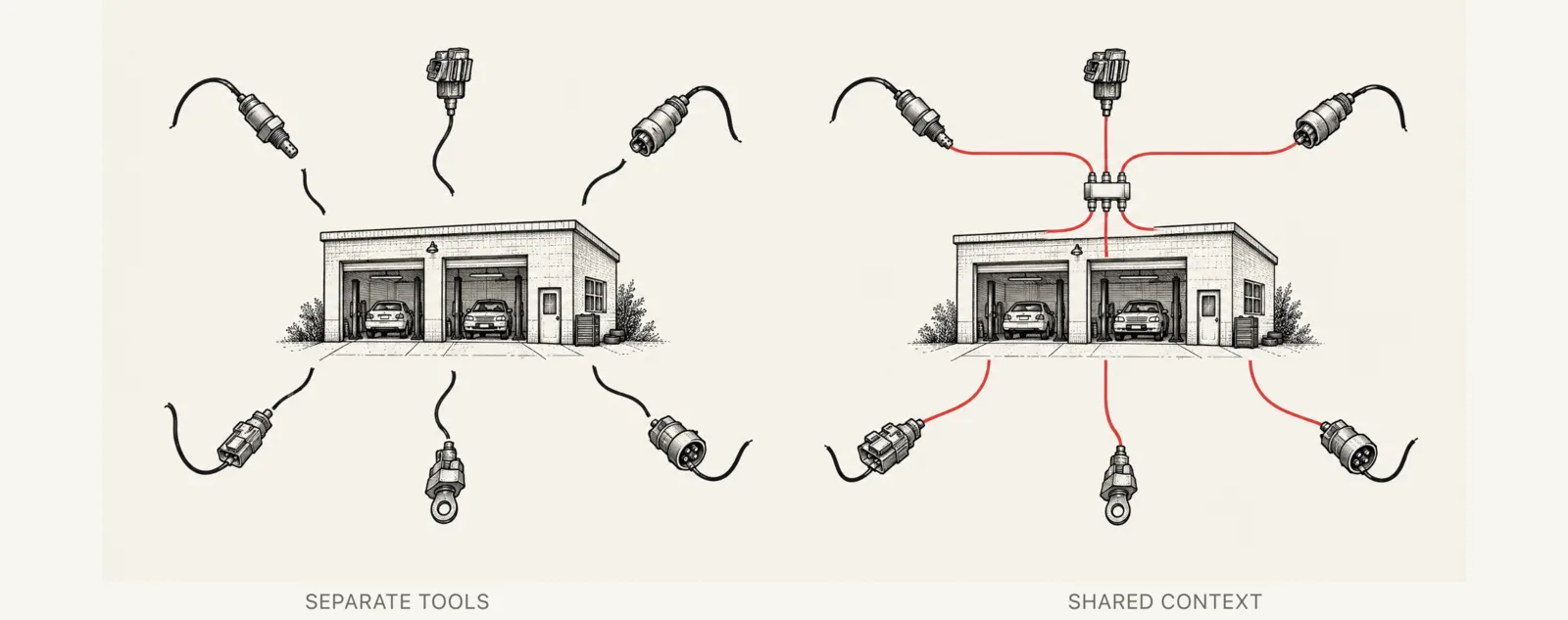
Same six tools, two shops. Category expertise still matters. The difference is whether they read one customer record and whether anyone owns the handoffs between them.
Is it a marketing problem or a shop problem?
A company that does one thing usually knows it well. For one clear problem, that's still worth a lot. But a lot of what's costing you money today doesn't fit in one box.
Is online booking a website problem or a front counter problem? Is weak marketing an ad problem if you miss calls every day? When you can't tell which ads paid off, is that marketing, or your tools not sharing what they know? If the schedule is already full, do you need more ads, or more control over what kind of work you're bringing in?
More and more, you have to look at the whole shop to answer that. That's the case for fewer, better-connected tools.
Does your shop management software already connect to what you need?
Before you buy anything new, check what you already own. Tekmetric's integrations directory, for example, lists connections across marketing, communications, parts, and accounting. Check the list your own system publishes before you assume every handoff needs new software.
A listed integration is where your questions start. Ask what information moves, in which direction, how fast, and what happens when something doesn't fit. Two products can be connected and still leave your advisor doing the important part by hand.
A good demo is only the start. You still need access to your own information, a clear owner for every problem, and a plan for when a connection breaks.
Should you hire a big auto repair marketing company or a small team?
If you look at the whole shop, a different kind of vendor can make sense. It's smaller and more technical, with no departments. It knows shops, and it knows software, marketing, and data.
Small isn't better by default. An established company can be more reliable, give better support, and sell a finished product. Custom technology can turn into an expensive science project. New vendors can go under. AI used carelessly produces as much nonsense as value.
A larger company has a deep bench of people who each do one thing. That matters if you need steady help with ads, your website, and reporting. A small senior team can fit too, if it shows the depth and staying power you need. Where it can win is fewer handoffs between spotting a problem and fixing it. The person running your ads talks directly to the person building your website. The developer understands your management system. Nothing has to climb an org chart before somebody's allowed to act on it.
For some shops that fits better. For others it won't. The industry standard isn't dead. It just shouldn't end the conversation. Every so often, ask yourself: if you set up these vendor relationships today, knowing what the technology can do now, would you set them up the same way?
Walk one real customer journey before you renew
A feature list won't tell you much. One real customer will. Before you renew a contract, do this with each vendor:
- Pick one real customer.
- Walk that customer's path together: inquiry, conversation, appointment, finished job.
- Ask who owns each gap.
- Ask how they'll notice when something slips through.
- Ask how you get your information out if you part ways.
When the technology changes, the companies that sell it have to change too. Their answers will show you which ones already have.
Questions shops ask
How do I choose auto shop software?
Start with the job you need done and the tools it has to work with, not the feature list. Ask what information moves between the new tool and your management system. Then walk one real customer through it with the vendor and see where a person still steps in.
Do I need a new shop management system?
Often you don't. Check the integrations your current shop management software already lists. The trouble is usually the handoff between tools, not the tool itself.
What should I ask an auto repair marketing company before I sign?
Ask them to follow one real customer from the first click to the finished repair order. Ask who owns the gaps, how they'll notice a lead slipping through, and how you get your data back if you leave.
Next step
If you want to see where your shop's online presence isn't connecting, start with a free visibility audit. We'll show you what's clear, what's missing, and what to fix first.