AI isn't just a trade show demo anymore. It's in most of a shop's day now. Here's a map of where AI for auto repair shops is working, area by area, and what a person still checks in each one.
The phone and the front counter
This is where most shops start, because it's where calls get missed.
- Answers the phone and texts back when nobody can pick up: after hours, the lunch rush, both advisors on a call.
- Answers "do you work on my make?" and "when can I bring it in?"
- Books only what your shop has told it it can.
- Transcribes and sums up voicemails, so nobody has to replay them.
- Sends the customer status updates: what the tech found, the photo, and why it matters.
- Handles Spanish and other languages, by text and at the counter.
- Sends reminders, wins back no-shows, and follows up on declined work, timed by mileage or season.
Your website has its own version of this. Read about the chat assistant on your website, and the AI telling drivers where to go.
What a person checks: what it's allowed to promise. A time slot, yes, within the rules you set. A price or a diagnosis, never. A booked job you can't do is worse than a missed call.
In the bay
Your techs are getting help finding the problem faster.
- Takes the customer's words plus the VIN and pulls up likely causes, the bulletins, and the repair procedure. The labor-guide platforms ship this now.
- Looks at inspection photos and flags what they show: worn tread, thin pads, a wet spot where a leak might be.
- Writes the inspection lines while the tech talks through the car.
What a person checks: the tech's finding is the fact. The AI's suggestion is a place to start looking. It isn't a diagnosis. Nothing goes on the inspection that the tech didn't see.
Estimates and selling the work
This is what most people mean by an AI service advisor. It does the typing so your advisor can do the talking.
- Builds the estimate: parts priced across suppliers, labor times, and canned jobs suggested from the concern.
- Turns findings into plain language, with the photo next to each one.
- Sorts what needs doing now from what can wait.
- Writes up the repair order from the call, the text, and the check-in.
- Drafts the added lines after the inspection.
- Tracks declined work and brings it back at the right time.
What a person checks: your advisor reads the write-up before it becomes the ticket. Then they read the added lines before those go on the estimate. A wrong part, a wrong labor line, or a concern that got "improved" costs real money. "Grinds on left turns when it's cold" shouldn't turn into "replace front wheel bearing."
The back office and the owner's desk
This is the work that eats your evenings.
- Checks closed repair orders for missed items, labor that doesn't match the guide, and pricing mistakes.
- Grades recorded calls against your own list: greet, ask for the vehicle, offer a time, ask for the booking. You coach from a weekly sheet.
- Writes the weekly report, so you're not putting it together on Friday.
- Loads the schedule around which techs can do what and how many bays are open.
- Does the bookkeeping: sorts expenses, syncs to your accounting, and chases unpaid invoices.
- Fills out warranty claim paperwork.
- Helps with hiring and training: job posts, screening, practice calls for a new advisor, and writing down how things are done.
What a person checks: the list the calls are graded against is yours, and it's written down. Someone spot-checks the grades before anyone gets coached on them. Numbers in a report get a second look before a decision rides on them.
Marketing and being found
AI now writes a lot of what customers read about your shop before they call.
- Writes service pages and posts from your closed repair orders, so they describe the work you actually do.
- Drafts ad copy, Google Business posts, and review requests.
- Drafts review replies and follow-up texts for a person to approve.
- Follows which ad became which appointment, and which appointment became which repair order.
- Lets you ask your own assistant how the business is doing, and change your website from the same chat.
What a person checks: anything that goes to a customer under your shop's name gets a person's approval first. A review reply is your shop talking.
Some of this comes with the tools you already have: the labor-guide platforms and the better shop management systems ship their own AI now. Some of it is what we build: the phone agent, call grading, review replies and follow-ups, service pages and attribution from repair orders, and the assistant an owner can ask about their own business.
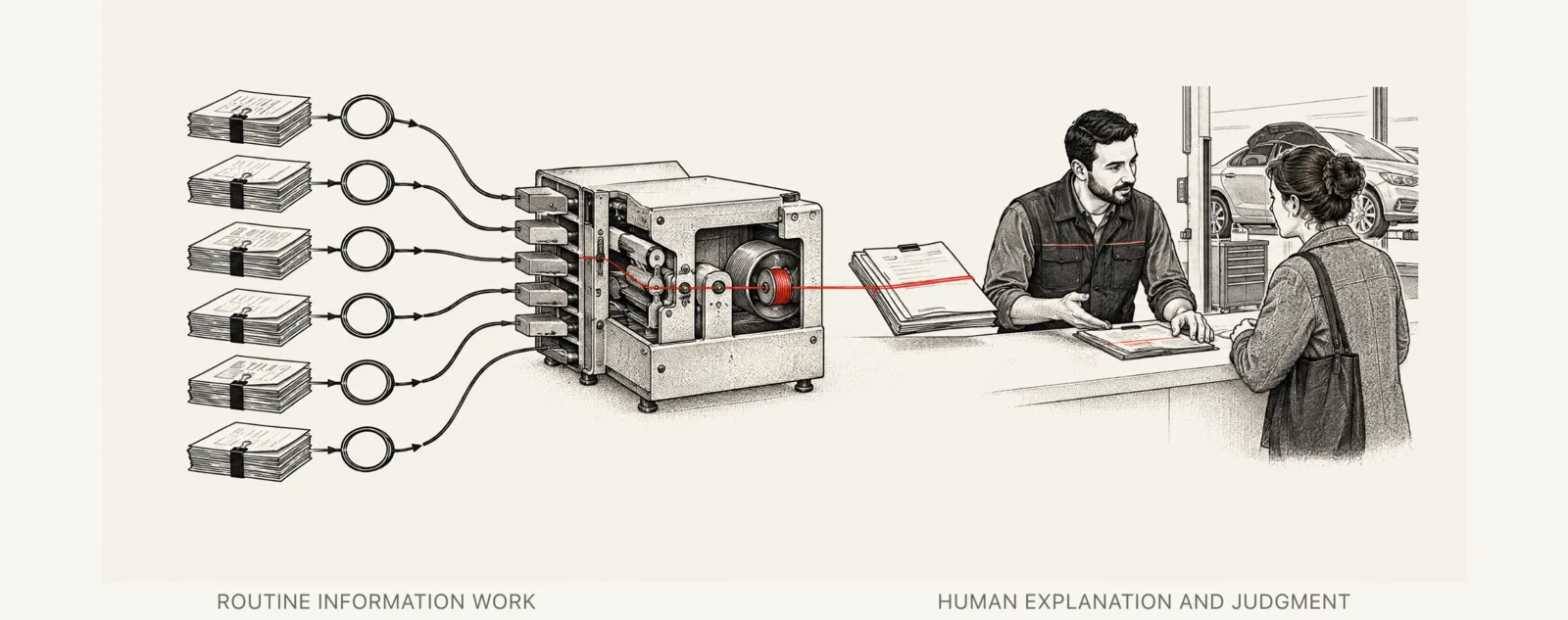
Left: the paperwork an AI can sort and draft, from call notes to write-ups to reports. Right: the explanation at the counter, which stays with your advisor. The machine feeds that conversation, and a person checks what it hands over.
Why a person checks, and what stays with your people
A smooth draft or a confident voice can include details nobody gave it. The National Institute of Standards and Technology's generative AI profile calls this confabulation. In plain words, the model can sound sure and still be wrong.
Keep these with your people, every time:
- The diagnosis.
- The completion time.
- The price.
- Anything that changes an approved estimate.
- Any promise on the phone your shop can't keep.
Does AI in auto repair actually save time?
Only if you count the checking.
Here's a hypothetical. An agent saves your advisor four minutes on each repair order write-up. Your advisor writes up twenty a day. That's eighty minutes, on paper. Reading each draft against the call and the inspection takes two minutes. In this hypothetical, the real saving is forty minutes a day, before the subscription and upkeep.
When a vendor shows you time saved, ask where the checking is in their math. Ask first whether your shop needs more software at all.
How to test AI on one task in your shop
- Pick one recurring task. After-hours calls or repair order write-ups are good places to start.
- Record a baseline. How long does it take today? How often is it wrong? Who cleans up the mistake?
- Run the new way alongside the old one. Go long enough to see the awkward cases too.
- Measure what you actually saved. Count the time saved after checking, and how often drafts need fixing.
- Decide where the freed time goes. Point it at follow-up calls or an unhurried talk with a nervous customer. If you don't give those minutes a job, they'll disappear.
- Bring in the person who does the task. You might see a repeated step as waste. Your advisor might know it catches a mistake that keeps coming back. Cut that step without asking, and you just get to the wrong answer faster.
Judge it by the work your people no longer have to do, and by what they do instead.
Questions shops ask
Can AI answer my shop's phone?
Yes. Shops use AI voice agents after hours and when every advisor is busy. Decide ahead of time what it can book and what it hands to a person.
Can AI write up a repair order?
It can draft the check-in write-up from the call and the customer's message. It can also draft the added lines after the inspection. Your advisor reads both before they go on the ticket, checking the parts, the labor, and that the concern still reads the way the customer said it.
What should a person still check?
Anything that goes to a customer under your shop's name. Anything that commits you to a time, a price, or a repair. Call grades get a spot-check before anyone is coached on them.
Next step
Before adding AI anywhere, it helps to know what customers and search engines already understand about your shop. A free visibility audit shows you what's clear, what's missing, and what to fix first.