The inspection photos and notes your technicians make every day are proof of honest work, and in many shops they go to one customer and stop there. Putting them where the next customer looks, on your Google Business Profile and your website, turns work your shop already did into marketing.
Somebody who has never met you is about to hand you their car. What they have to go on is a star rating, a few photos of your building, and your word that you're honest.
Meanwhile, picture one of your bays this morning. A technician pulled the wheels, measured the brake pads, and took a picture of the fronts. The tech's note said: fronts at 3 mm, they need doing. Rears at 7 mm, those can wait. The advisor texted it to the customer, who approved the fronts.
That note may be the best marketing your shop made all day. It showed the work, explained it in plain words, and told the customer what they did not need to buy yet. Only that one customer saw it.
The next customer never sees your inspections
Every shop says it's honest. Every shop says it does quality work. A stranger can't tell which shop means it, because the words read the same on every website.
In AAA's national survey, two out of three U.S. drivers said they do not trust auto repair shops in general (AAA, December 2016).
Proof tells a stranger which shop means it. A photo of the actual part, a measurement, or a tech explaining what they found the way they'd tell a neighbor.
Your shop makes that proof all day. It goes out in a text to the one customer already in your building and stops there. The person choosing between you and the shop down the road never sees it.
And they do go looking. In BrightLocal's 2026 survey of 1,002 U.S. adults, 97 percent said they read reviews for local businesses.
After reading positive reviews, the most common next step was visiting the business's website, at 54 percent. Two thirds kept researching before they bought or booked anything (BrightLocal, February 2026). For a lot of them, your website is the next stop after the reviews.
"This can wait" is the most believable thing your shop says
A customer walking into a repair shop expects to be sold something. "Your rears have plenty of life left" is not what they expect to hear from a shop.
The same AAA survey asked why. Among drivers who don't trust repair shops, the top reason was shops recommending unnecessary services, named by 76 percent. Overcharging was second at 73 percent.
A good inspection says "this can wait" all day long. Some items need attention now, some need watching, and some are fine. That last group earns trust, and it almost never makes it into a shop's marketing.
A job story is a short write-up of one real job. A good one says something like: "We replaced the front pads and rotors, and the rears measured fine." That does more for the next customer than any sentence with the word "trust" in it.
One rule: publish the work you did and what checked out fine. Work the customer chose to put off stays on the estimate and in the follow-up call. That is the customer's private business, so don't post it.
What to photograph and write down
Four things, and your techs already do most of them on every inspection.
- The finding. One photo of the worn or failed part, in focus, with enough around it to tell what it is. If there's a measurement, get the gauge in the shot with the reading clear enough to see.
- The tech's note. Two sentences in plain words: what it is and why it matters. The way the tech would say it at the counter, not the way it reads in a service manual.
- What checked out. The things the tech inspected that are fine. Most shops skip this, and it's the part a stranger believes fastest.
- The finished work. The new part installed, clean, before everything gets buttoned back up. Most inspections stop at the finding, so this is usually the one photo nobody takes.
When the customer picks up the car, the advisor asks for an honest review. A customer who got photos and a straight answer has something specific to write about.
A text that works: "Thanks for coming in today. If you're willing to leave an honest review of how we did, here's the link."
Send it to every customer, not just the ones you expect to be happy. Google's review rules don't allow asking only the customers you think will leave good reviews.
Asking works. In the same BrightLocal survey, 83 percent of people who were asked for a review went on to leave one.
The photos already pay off at the counter, too. A 2026 report from inspection software company Detect Auto drew on its own data plus AutoVitals and Tekmetric. It tied strong digital inspections to average repair orders 27 to 28 percent higher. Inspections with 20 or more photos produced repair orders roughly 30 percent higher than those with five or fewer (Ratchet+Wrench, August 2026).
Those are software vendors' numbers, so take them as a rough guide. Either way, showing the photos to the next customer gets a second use out of work that's already done.
Where to put the photos and notes
Put the photos and notes where a new customer looks before calling.
- Your Google Business Profile. That's your shop's listing on Google Search and Maps. For many customers, it's where they find your shop first. Add photos of real work, and post short updates built from real jobs. Those tell a stranger more than a picture of the sign out front.
- Your website. A job story belongs on the service page for that work, so a brake job goes on your brake page. We covered turning a finished repair order into a service page in Your repair orders are the service pages customers are looking for. The inspection photos make that page believable. Give each photo a one-line caption, and the same description in the image's alt text, so the customer and Google can tell what it shows.
- Your reviews. You can't write them, and you shouldn't coach them. You can make sure every customer leaves with something specific to mention.
- AI assistants. When somebody asks an AI assistant which shop to trust with their brakes, it answers from what's posted online. Your own site and your Google profile are the parts you control. More on that in our post on website chat and AI recommending shops.
That last one grew fast. In one year, the share of people asking AI tools like ChatGPT to recommend local businesses rose from 6 to 45 percent (BrightLocal).
Google's guidance on helpful content asks whether a page clearly shows first-hand expertise. It also says trust is the most important quality its systems look for (Google Search Central). Google's Business Profile photo guidelines say an image should represent reality (Google Business Profile Help).
A photo of a real part from a real job meets those guidelines. A stock photo of a smiling mechanic doesn't show your shop at all.
What this looks like on a real shop's site
We write these up for one of our clients, an auto repair shop. Each one is a short write-up of a real job from its bays, posted on the shop's own website. No customer names and no plates. Each job gets the same three parts: what the driver noticed, what the tech found, and what the shop did about it.
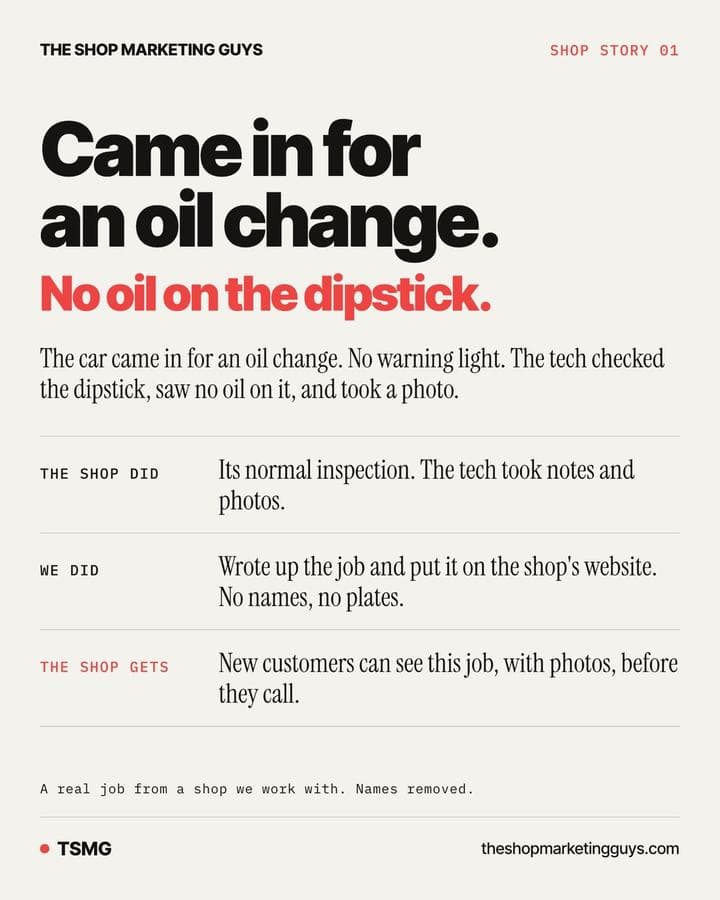
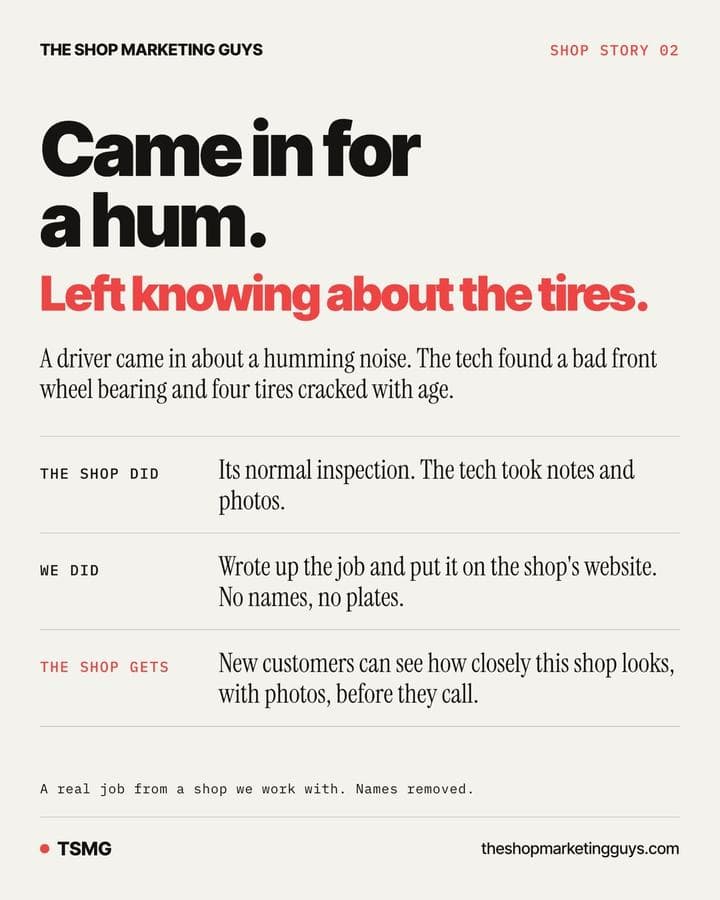
Two jobs from one recent post:
- The oil change. A car came in for a routine oil change. The tech pulled the dipstick and found no oil showing on it. There was no warning light and nothing the driver could feel. The shop photographed it and changed the oil. It asked the owner to come back for a level check, to find out where the oil is going.
- The hum. A driver came in about a noise that rose and fell with road speed. The tech road tested it, put it on the lift, and traced it to a front wheel bearing. The inspection also turned up four tires cracked with age and unsafe at highway speed, which the owner had not asked about.
That post ends by saying why the shop bothers: someone was looking, and wrote it down with photos, so the owner could decide with the proof in hand.
Nothing in that post was made for marketing. It was already in the inspection the shop did. We turned it into a page the next customer can read before they call.
Keep the routine small
Shops usually stop doing this for one reason: it's nobody's job. The fix is small on purpose.
- Don't turn techs into content creators. Nobody in the bay should be posting, editing, or thinking about captions.
- Ask for one extra photo. On one job a day, the tech takes the finished shot as well as the finding. Say it like this: "Before you button it up, get me one photo of the new part in."
- Have the advisor flag one inspection a day, the one with the clearest photos and the plainest note.
- Hand the flagged job to whoever handles your marketing. Tell them: "Turn this into one Google Business Profile post and one job story. Show me both before they go out."
Follow three rules every time. No license plates, VINs, or customer names. Nothing personal visible inside the car, like mail, the registration card, or a phone screen. And a tech's name or face goes on it only when that tech is good with it.
What to check on your own setup
- Open the last ten inspections your shop sent, in your inspection software or the advisor's sent texts. Count the photos a stranger would understand without the tech there to explain them. You want at least one on every inspection.
- Read the tech notes on those ten out loud. If a customer couldn't follow a note, the next customer can't either. Ask the tech to write it the way they'd say it at the counter.
- Search your shop's name on Google and open the photos on your Google Business Profile. Count how many show actual work and how many show the building and the waiting room. Check the date on the newest one. If it's all building, or the newest is months old, have whoever runs the profile add one photo of real work this week.
- Read your last ten Google reviews. See if any mention what the tech found or explained, or if they all say "great service." If they all do, have the advisor send the review text above at every pickup.
- Ask your advisors: "Where do the inspection photos go after the customer approves the work?" If the answer is "nowhere," that's the problem. Start flagging one inspection a day.
How The Shop Marketing Guys handles this
For client shops, The Shop Marketing Guys does the marketing side of the routine above. We draft Google posts and job stories from the shop's actual jobs, and the owner approves each draft before anything goes out. We keep the shop's Google Business Profile current and send review requests after jobs. The job stories go on the shop's own website, which we build so search engines and AI assistants can read it, including structured data for its services.
Frequently asked questions
Do I need the customer's permission to use inspection photos?
Asking is the safe default, and it takes one line at pickup: "Mind if we use a photo of the repair on our website? No name, no plate." Your own privacy policy and the rules where you are decide whether you have to.
Either way, publish the work, not the customer. Take out plates, VINs, names, and anything personal in the frame. For anything with the customer on camera or in their own words, ask first, every time.
My techs don't want to be on camera. Does this still work?
Yes. The part, a pair of hands, and a plain note are enough. Nobody has to talk to a camera. If a tech likes explaining things on video, that's a bonus, not a must.
Won't showing "this can wait" cost me work?
No. That work wasn't needed today, so you weren't going to sell it today. When it does come due, that customer already knows your shop told them straight.
We don't use digital inspections. Where do we start?
With the phone already in the tech's pocket. One photo of the finding, one of the finished work, and two sentences from the tech. Do that on one job a day for a month and you'll have a month of real proof.
What does The Shop Marketing Guys do with a shop's inspection photos and notes?
The Shop Marketing Guys drafts Google Business Profile posts and short job stories from a client shop's real jobs, using the photos and the tech's notes. The shop owner approves every draft before anything is posted. The job stories go on the shop's own website, which The Shop Marketing Guys builds so search engines and AI assistants can read it.
Next step
To see what a stranger sees when they look up your shop, start with a free visibility audit.
Sources
- Most U.S. Drivers Leery of Auto Repair Shops, AAA, December 1, 2016
- Local Consumer Review Survey 2026, BrightLocal, February 11, 2026
- Creating helpful, reliable, people-first content, Google Search Central
- Manage your Business Profile photos and videos, Google Business Profile Help
- State of Inspection Intelligence: Why Only 1 in 10 Auto Shops Successfully Grow, Ratchet+Wrench, August 4, 2026
Written by Jay Carroll, co-founder of The Shop Marketing Guys. Jay has spent about ten years in auto repair marketing.